
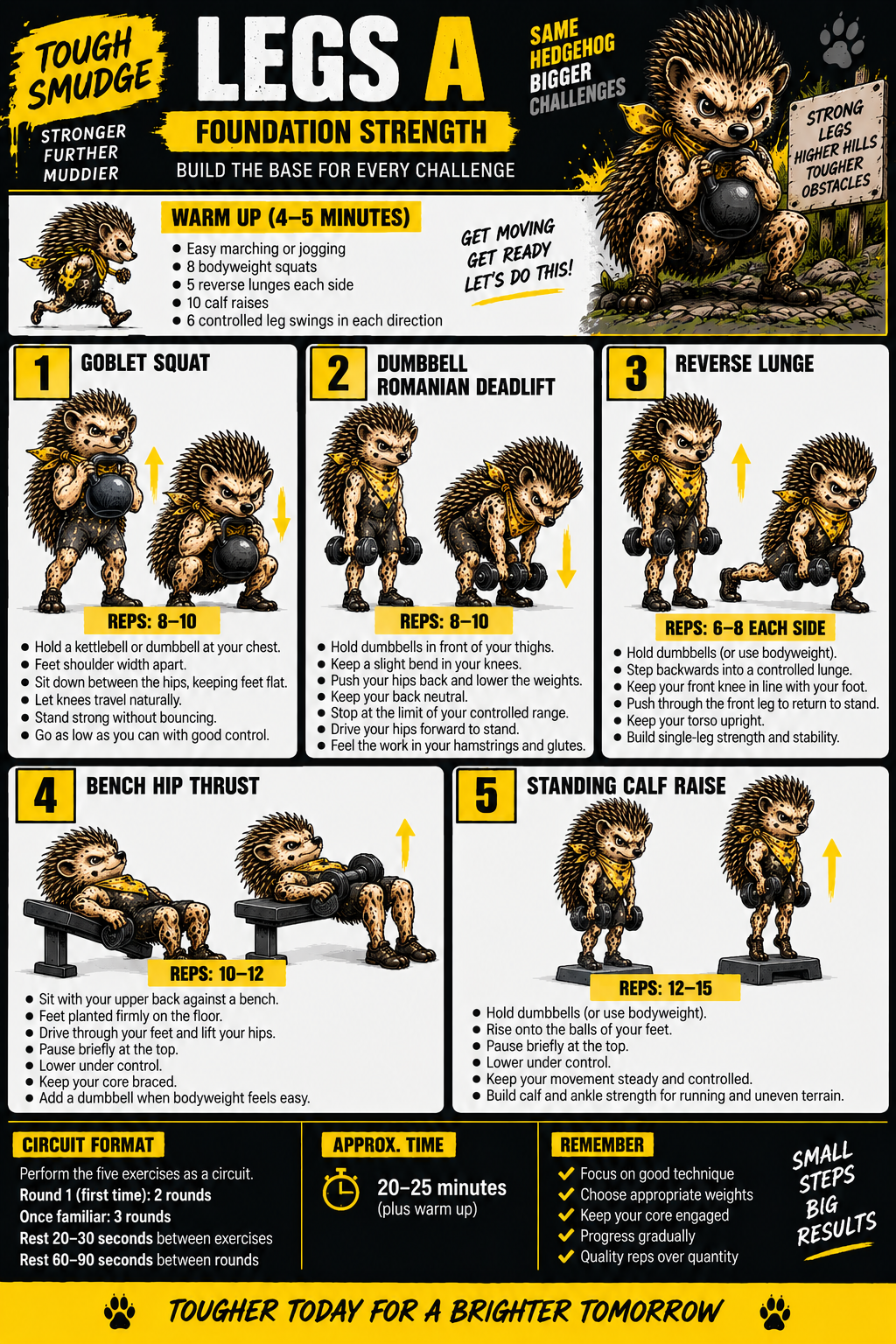
With the Core and Upper Body programmes now in place, the final part of the initial Tough Smudge strength programme is the legs.
Running, walking, Peloton training and obstacle course racing already place a considerable workload on the lower body, so this programme is not about simply adding as much leg training as possible. The aim is to build the strength, control and resilience that should make those activities easier to cope with.
Tough Smudge Legs Programme: Cycle 1 therefore focuses on squat strength, the posterior chain, single-leg control, climbing strength, calves and the ability to continue producing force as the legs begin to fatigue.
Unlike the Core and Upper Body programmes, which use three structured sessions each week, Legs Cycle 1 uses two dedicated lower-body workouts per week. My legs are already receiving considerable training from running, walking, cycling and events, so the objective is to complement that workload rather than overwhelm it.
This first four-week cycle provides the foundation. Later cycles can progressively introduce heavier loading, greater single-leg demands, power, jumping and landing, hill-specific strength, loaded carries and more OCR-specific combinations.
Training plan
Common format
Allow approximately 4–5 minutes to warm up before starting the workout.
- easy marching or jogging;
- 8 bodyweight squats;
- 5 reverse lunges each side;
- 10 calf raises; and
- 6 controlled leg swings in each direction.
Then perform the five exercises in the workout as a circuit.
For the first exposure to each workout, complete 2 rounds. Once the movements are familiar, increase to 3 rounds.
Allow approximately 20–30 seconds between exercises while changing position or equipment, and roughly 60–90 seconds between complete rounds.
The complete workout should generally take approximately 20–25 minutes.
This is strength training rather than cardio disguised as resistance work. Take enough recovery to perform the movements properly.
Weekly schedule
Leg A is the foundation session and appears every week. The second workout alternates between Leg B, with an emphasis on running and hill strength, and Leg C, which starts introducing more OCR-specific lower-body work.
| WEEK 1 LEARN | WEEK 2 ADD VOLUME | WEEK 3 PROGRESS SELECTIVELY | WEEK 4 CONSOLIDATE | |
|---|---|---|---|---|
| SESSION 1 | Leg A: Foundation Strength | Leg A: Foundation Strength | Leg A: Foundation Strength | Leg A: Foundation Strength |
| SESSION 2 | Leg B: Running & Hill Strength | Leg C: OCR & Endurance Legs | Leg B: Running & Hill Strength | Leg C: OCR & Endurance Legs |
| ROUNDS | 2 rounds | Leg A: 3 Leg C: 2 | 3 rounds | 3 rounds |
Ideally the two leg sessions should be separated by at least 48 hours, and the more demanding session should not sit immediately before an important run, parkrun or event.
Week 1: Learn
Leg A + Leg B. Two rounds of each.
The objective is to learn the movements and establish appropriate starting positions, weights and ranges of movement.
In particular, this week should establish comfortable squat depth, sensible lunge positions, the appropriate height for step-ups and how much balance assistance is required for the single-leg exercises.
Finish each session knowing that more would have been possible.
Week 2: Add volume
Leg A moves to 3 rounds.
Leg C is introduced for the first time, so it remains at 2 rounds.
There is no benefit in immediately performing three rounds of unfamiliar exercises simply because the programme has reached Week 2.
This week also introduces the first deliberately OCR-focused lower-body work.
Week 3: Progress selectively
Return to Leg A and Leg B, now completing 3 rounds of each.
Where an exercise felt comfortably manageable during its previous appearance, choose one progression:
- increase from 8 repetitions towards 10;
- use a slightly heavier dumbbell or kettlebell;
- increase the step height slightly;
- progress from bodyweight to a light external load;
- increase a 30-second hold towards 40 seconds; or
- increase the range of movement while maintaining control.
Don’t increase every variable at the same time. The objective is progressive overload while preserving good technique.
Week 4: Consolidate
Complete Leg A and Leg C for 3 rounds.
Every workout has now been performed at least twice, so the aim is to consolidate the progress made during the previous three weeks.
Aim for approximately RPE 7–8/10 on the more demanding exercises while maintaining controlled movement.
At the end of the cycle, record the weights, repetitions, step height and endurance holds achieved. Those figures become the starting point for Legs Cycle 2.
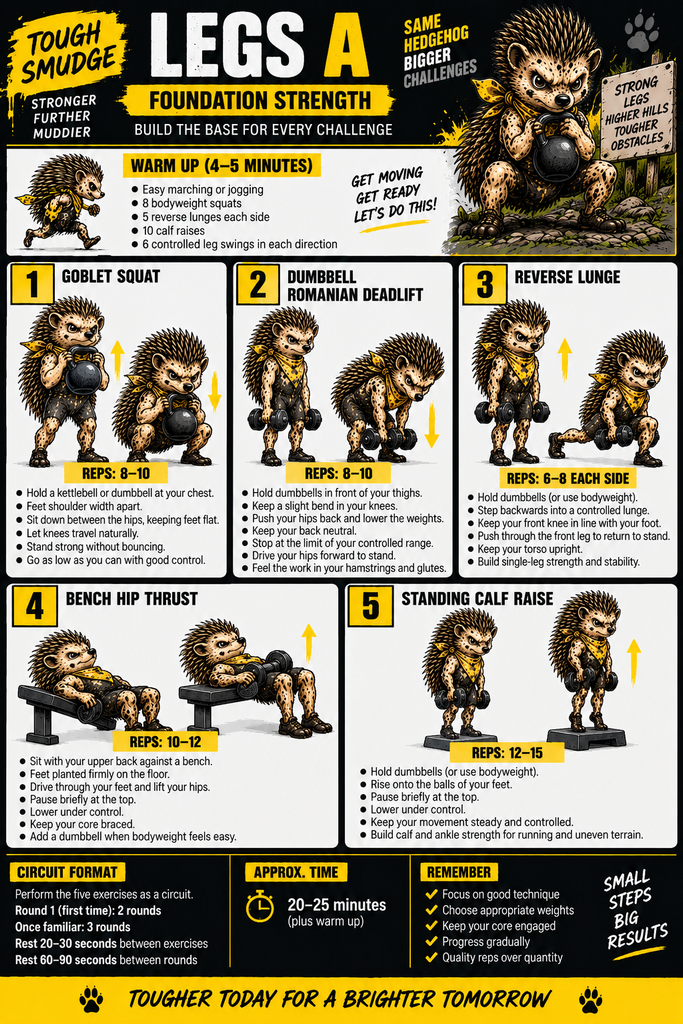
Leg A: Foundation Strength
Leg A is the foundation workout and appears every week. It covers the fundamental lower-body movement patterns: squatting, hinging, single-leg strength, hip extension and calf strength.
| EXERCISE | REPS | PURPOSE |
|---|---|---|
| Goblet squat | 8–10 | Quads, glutes and general leg strength |
| Dumbbell Romanian deadlift | 8–10 | Hamstrings, glutes and hip hinge |
| Reverse lunge | 6–8 each side | Single-leg strength and stability |
| Bench hip thrust | 10–12 | Glute strength |
| Standing calf raise | 12–15 | Calves and ankle strength |
Goblet squat
Hold a kettlebell or dumbbell vertically against the chest.
Stand approximately shoulder width apart and lower into a squat while keeping the whole foot in contact with the floor.
Allow the knees to travel naturally and stand strongly back to the starting position.
For Cycle 1, squat depth is determined by how far I can move while remaining controlled. There is no benefit in forcing additional depth if technique starts to disappear.
Dumbbell Romanian deadlift
Hold the dumbbells in front of the thighs with a small bend in the knees.
Push the hips backwards while allowing the dumbbells to travel down the legs.
Keep the back neutral and stop when the limit of the controlled hip movement is reached.
Drive the hips forwards to return to standing.
The objective is tension through the hamstrings and glutes, not reaching the dumbbells all the way to the floor.
Reverse lunge
Step backwards and lower under control.
Push through the front leg to return to standing.
Begin with bodyweight if necessary and introduce dumbbells once the movement is stable and repeatable.
This starts developing the single-leg strength and stability that running, hills and uneven ground repeatedly demand.
Bench hip thrust
Sit with the upper back supported against the bench and the feet planted firmly on the floor.
Drive through the feet and extend the hips.
Pause briefly at the top, then lower under control.
Avoid achieving additional height simply by excessively arching the lower back.
Once bodyweight becomes straightforward, a dumbbell or kettlebell can be placed securely across the lap.
Standing calf raise
Rise deliberately onto the balls of the feet.
Pause briefly at the top and lower under control.
Cycle 1 starts with both legs working together. Later cycles can progress towards heavier and single-leg variations.
The calves perform thousands of repeated contractions during a long running event, so they are not being treated as an afterthought.
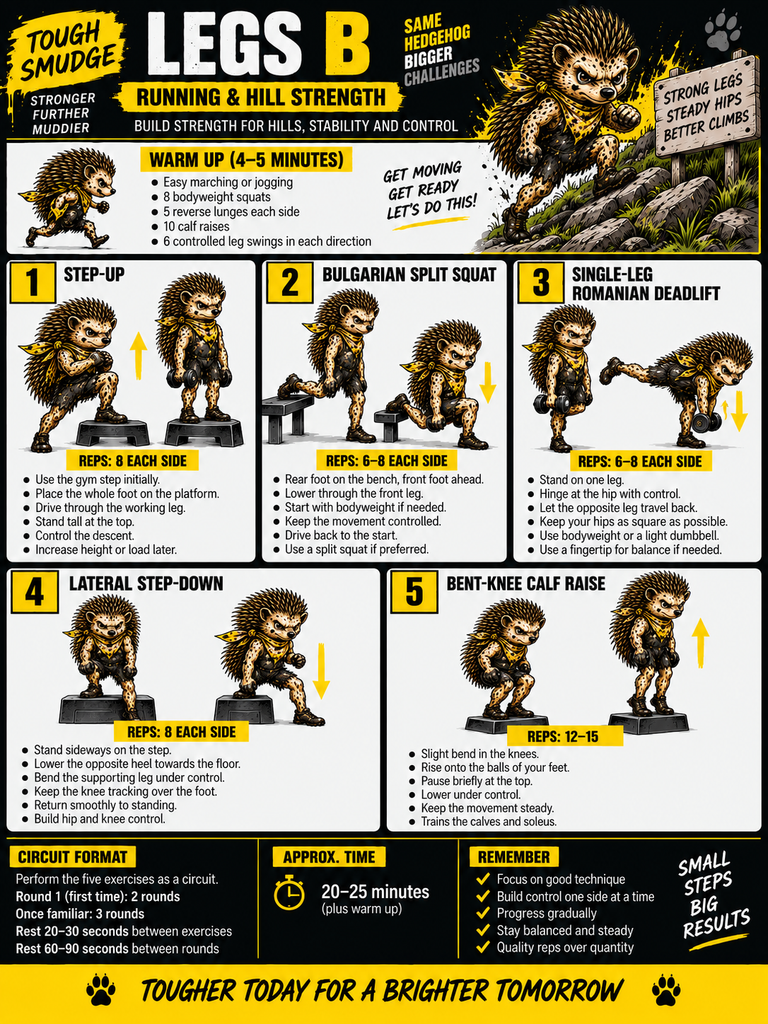
Leg B: Running & Hill Strength
Leg B places greater emphasis on single-leg strength, climbing mechanics, hip and knee control and the muscles that have to repeatedly stabilise the body while running over uneven ground.
| EXERCISE | REPS | PURPOSE |
|---|---|---|
| Step-up | 8 each side | Hill and climbing strength |
| Bulgarian split squat | 6–8 each side | Single-leg strength |
| Single-leg Romanian deadlift | 6–8 each side | Hamstrings, glutes and balance |
| Lateral step-down | 8 each side | Hip and knee control |
| Bent-knee calf raise | 12–15 | Soleus and calf endurance |
Step-up
Use the gym step initially and place the whole foot on the platform.
Drive through the working leg and stand on top rather than launching upwards with the trailing foot.
Control the descent as well as the climb.
Later progression can come from increasing the step height or introducing additional load.
Bulgarian split squat
Place the rear foot on the bench with the front foot positioned comfortably ahead.
Lower through the front leg under control before driving back to the starting position.
Start with bodyweight. This movement can become demanding very quickly, so there is no need to add significant load during Cycle 1.
If the rear-foot-elevated position is uncomfortable, use a conventional stationary split squat instead.
Single-leg Romanian deadlift
Stand on one leg and hinge at the hip while the opposite leg travels backwards.
Keep the hips as square as possible and move only as far as can be controlled.
The progression can move from bodyweight → one light dumbbell → heavier load.
This is a strength exercise, not a balance competition. Using a fingertip against the bench while learning the movement is perfectly acceptable.
Lateral step-down
Stand sideways on the gym step with one foot unsupported.
Slowly bend the supporting leg and lower the opposite heel towards the floor.
Return to standing while keeping the knee tracking in approximately the same direction as the foot.
This introduces controlled loading in a slightly different plane, which becomes useful when the ground is not perfectly flat or movement is not purely forwards and backwards.
Bent-knee calf raise
Bend the knees slightly and maintain that position while performing controlled calf raises.
The bent-knee position changes the emphasis compared with the straight-leg calf raises in Leg A and provides additional work for the soleus.
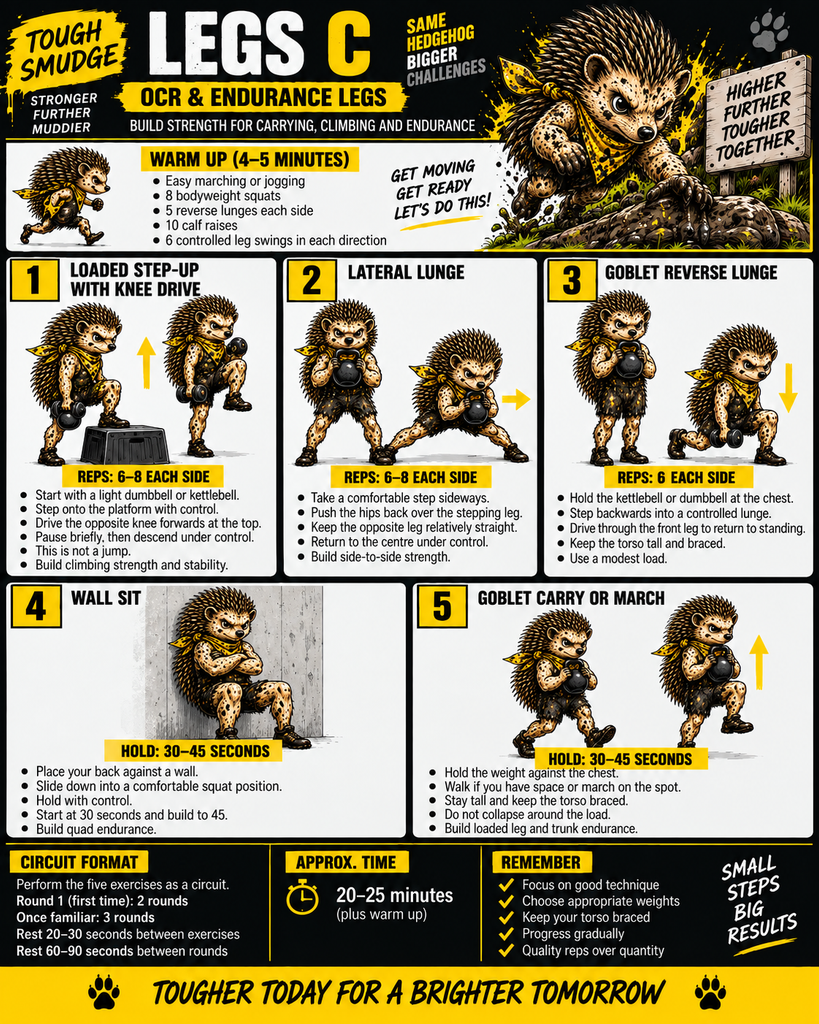
Leg C: OCR & Endurance Legs
Leg C starts moving the programme towards the less predictable demands of obstacle course racing. The exercises introduce loaded climbing, sideways movement, longer periods under tension and carrying weight while the legs continue to work.
| EXERCISE | REPS | PURPOSE |
|---|---|---|
| Loaded step-up with knee drive | 6–8 each side | Climbing strength and stability |
| Lateral lunge | 6–8 each side | Side-to-side strength |
| Goblet reverse lunge | 6 each side | Loaded unilateral strength |
| Wall sit | 30–45 seconds | Quad endurance |
| Goblet carry or march | 30–45 seconds | Loaded leg and trunk endurance |
Loaded step-up with knee drive
Start with a light dumbbell or kettlebell.
Step onto the platform and, as the body reaches the top, bring the opposite knee forwards into a controlled knee drive.
Pause briefly before descending under control.
This is not intended to become a jump. The aim is controlled strength and stability through a movement that begins to resemble climbing.
Lateral lunge
Take a comfortable step sideways and push the hips backwards over the stepping leg while keeping the opposite leg relatively straight.
Return to the centre under control.
Running is predominantly forwards, but obstacle racing, uneven terrain and awkward footing can demand strength in other directions. This movement begins addressing that gap.
Goblet reverse lunge
Hold the kettlebell or dumbbell against the chest.
Step backwards into a controlled lunge before driving through the front leg to return to standing.
Use a modest load. The front-loaded weight increases the demand on the legs while also requiring the trunk to remain braced.
Wall sit
Place the back against a wall and slide down into a comfortable squat position.
Hold for 30 seconds initially, progressing towards 45 seconds.
This is the deliberate muscular-endurance element of the workout.
It also provides a useful reminder that 45 seconds can become a surprisingly long period of time.
Goblet carry or march
Hold the kettlebell or dumbbell against the chest.
Walk if sufficient space is available or march deliberately on the spot for 30–45 seconds.
Stay tall and avoid allowing the torso to collapse around the weight.
This is deliberately different from the farmer hold or march in the Upper Body programme. There, grip and forearm endurance are an important part of the exercise. Here, the load is kept close to the body so that the emphasis remains on supporting and moving weight with increasingly tired legs.
TOUGH SMUDGE CORE WALLCHARTS
The three Cycle 1 workouts are also available below as quick-reference wallcharts. I use these in the gym so that the session can be followed without continually checking the full training guide.
What isn’t in Cycle 1?
There are some obvious lower-body exercises deliberately missing from the first cycle.
Kettlebell swings, squat jumps, box jumps, jump lunges and other plyometric movements may all have a place later, particularly as the programme moves towards OCR power and obstacle performance.
For Cycle 1, however, the priority is strength and movement quality first.
Later cycles can progressively introduce power, jumping and landing, heavier unilateral work, hill-specific strength, longer loaded carries and exercises performed in deliberately fatigued combinations.
Completing the strength foundation
With Legs Cycle 1 added, the first Tough Smudge strength programme now has three distinct parts.
| PROGRAMME | MAIN PURPOSE |
|---|---|
| Core Cycle 1 | Brace, stabilise and transfer force |
| Upper Body Cycle 1 | Push, pull, hang and grip |
| Legs Cycle 1 | Squat, hinge, climb and endure |
These are not intended to become nine independent workouts scattered randomly across the week. They are three complementary parts of the same strength foundation, designed to sit alongside running, cycling, walking and event-specific training.
The balance matters. Strength work should support endurance and obstacle performance rather than leave the body too fatigued to run, ride or recover properly.
Cycle 1 is therefore about establishing the basics: learning the movements, building good technique and creating a set of measurable starting points that can be developed through later cycles.
Core. Upper body. Legs. Together, they provide the foundation for becoming stronger, more resilient and better prepared for whatever the course puts in the way.
This is the training programme I am developing and following as part of my own preparation for obstacle course and endurance events. It is not personalised fitness or medical advice. Exercise should be adapted to your own ability and circumstances, and any movement causing pain should be stopped.