With the first Tough Smudge Core Programme in place, the next part of the training plan is the upper body.
For obstacle course racing, that means considerably more than simply training chest and arms. Tough Mudder obstacles demand pushing, pulling, hanging, carrying, shoulder stability and, perhaps most importantly, the ability to keep hold of something when the rest of the body is already tired.
So Tough Smudge Upper Body Programme: Cycle 1 is designed around general upper-body strength, pulling ability and grip endurance, with exercises that can progressively become more OCR-specific in later cycles.
This first four-week cycle is the foundation. The aim is to learn the movements, establish sensible starting weights and build strength that can then be progressively developed through Cycles 2, 3 and beyond.
Training plan
Common format
Allow approximately 3–4 minutes to warm up before starting the workout. This should include some shoulder and arm movement followed by a few light repetitions of pushing and pulling movements.
Then perform the five exercises in each workout as a circuit.
Week 1: 2 rounds
Weeks 2–4: 3 rounds
Allow roughly 15–30 seconds between exercises while changing position or equipment, and approximately 60 seconds between complete rounds.
Take longer where necessary after the more demanding exercises. The objective is strength and control rather than completing the circuit as quickly as possible.
Each upper-body workout should take approximately 20–25 minutes.
Weekly schedule
There are three workouts: Upper A, Upper B and Upper C. Each is completed once per week.
The training days alternate between weeks. Weeks 1 and 3 use Monday, Wednesday and Friday, while Weeks 2 and 4 use Tuesday, Thursday and Saturday.
This deliberately matches the Tough Smudge Core Programme. Upper A is followed by Core A, Upper B by Core B and Upper C by Core C, creating three complete strength-training days rather than spreading strength work across six separate days.
| WEEK 1 LEARN | WEEK 2 ADD VOLUME | WEEK 3 PROGRESS SELECTIVELY | WEEK 4 CONSOLIDATE | |
|---|---|---|---|---|
| MONDAY | Upper A: Push, Pull & Foundation | – | Upper A: Push, Pull & Foundation | – |
| TUESDAY | – | Upper A: Push, Pull & Foundation | – | Upper A: Push, Pull & Foundation |
| WEDNESDAY | Upper B: Pulling, Shoulders & Grip | – | Upper B: Pulling, Shoulders & Grip | – |
| THURSDAY | – | Upper B: Pulling, Shoulders & Grip | – | Upper B: Pulling, Shoulders & Grip |
| FRIDAY | Upper C: OCR Strength & Endurance | – | Upper C: OCR Strength & Endurance | – |
| SATURDAY | – | Upper C: OCR Strength & Endurance | – | Upper C: OCR Strength & Endurance |
| SUNDAY | Recovery | Recovery | Recovery | Recovery |
| ROUNDS | 2 rounds | 3 rounds | 3 rounds | 3 rounds |
Week 1: Learn
2 rounds.
The objective this week is to learn the exercises, establish good technique and find appropriate starting weights.
For exercises prescribed at 8–10 repetitions, choose a weight where another two or three good repetitions would probably still have been possible.
Record the weights and exercise variations used. These will provide the starting point for future progression.
Week 2: Add volume
Move to 3 rounds.
Keep the weights, repetitions and exercise variations largely unchanged. The additional round already represents a significant increase in total training volume.
The aim is to complete the extra work while maintaining the same standard of technique established during Week 1.
Week 3: Progress selectively
Where an exercise now feels comfortably manageable, progress one variable at a time.
- increase from 8 repetitions towards 10;
- increase the dumbbell or kettlebell weight;
- extend a 30-second hold towards 40 seconds;
- use a slightly more difficult push-up or pull-up variation; or
- slow the lowering phase of an exercise to increase control.
Don’t increase every exercise simultaneously. The objective is progressive overload without sacrificing movement quality.
Week 4: Consolidate
Complete 3 strong rounds using the progress made during the previous three weeks.
Aim for approximately RPE 7–8/10 on the more demanding exercises. The final repetitions should feel challenging, but technique should remain controlled.
At the end of the week, record the weights, repetitions, pull-up variation and hanging time achieved. These results will provide the baseline for Upper Body Cycle 2.
Upper A: Push, Pull & Foundation Strength
Upper A establishes the basic pushing and pulling movements. Chest, shoulders, arms and back are all involved, but the emphasis is on controlled compound exercises that provide the foundation for more demanding OCR-specific training later.
| EXERCISE | REPS | PURPOSE |
|---|---|---|
| Dumbbell bench press | 8–10 | Chest, shoulders and triceps |
| One-arm dumbbell row | 8–10 each side | Back, lats and biceps |
| Seated dumbbell shoulder press | 8–10 | Shoulders and triceps |
| Bent-over reverse fly | 10–12 | Rear shoulders and upper back |
| Hammer curl | 10–12 | Biceps, brachialis and forearms |
Dumbbell bench press
Set the bench flat and lie back with a dumbbell in each hand.
Keep the shoulder blades gently drawn back against the bench. Lower the dumbbells under control until they are roughly level with the chest, then press them upwards.
Avoid allowing the shoulders to roll forwards at the bottom of the movement.
Cycle 1 is about controlled repetitions rather than testing maximum weight.
One-arm dumbbell row
Support one hand on the bench and hold the dumbbell in the opposite hand.
Pull the dumbbell towards the hip, pause briefly at the top, then lower it under control.
Try to keep the torso relatively still rather than twisting upwards as the weight moves.
Seated dumbbell shoulder press
Raise the back of the bench and sit with the dumbbells around shoulder height.
Press the weights overhead while keeping the torso controlled.
Avoid excessively arching the lower back simply to move a heavier weight.
Bent-over reverse fly
Use relatively light dumbbells and hinge forwards from the hips while maintaining a neutral back.
Raise the arms outwards under control, concentrating on the rear shoulders and upper back.
This should be considerably lighter than the pressing and rowing exercises. Avoid turning it into another heavy row.
Hammer curl
Hold the dumbbells with the palms facing towards each other.
Curl the weights towards the shoulders while keeping the elbows controlled and avoiding swinging the body backwards.
The neutral grip works the arms while also providing useful forearm involvement for later grip training.
Upper B: Pulling, Shoulders & Grip
Upper B begins to move the programme more directly towards obstacle course racing. Vertical pulling, shoulder strength and grip endurance become increasingly important when the obstacle requires me to support, move or pull my own bodyweight.
| EXERCISE | REPS | PURPOSE |
|---|---|---|
| Pull-up progression | 4–6 | Vertical pulling strength |
| Incline dumbbell press | 8–10 | Upper chest, shoulders and triceps |
| Dumbbell lateral raise | 10–12 | Shoulder strength and control |
| Overhead dumbbell triceps extension | 10–12 | Triceps strength |
| Farmer hold or march | 30–45 seconds | Grip, forearms and shoulder endurance |
Pull-up progression
Use the most appropriate variation that allows controlled repetitions.
Scapular pull-up → assisted pull-up → controlled negative → full pull-up.
For a negative repetition, begin at the top of the movement and lower as slowly and deliberately as possible.
The goal is not to claim a particular number of pull-ups. The goal is to progressively increase the amount of my own bodyweight I can control.
Incline dumbbell press
Set the bench to a modest incline and hold a dumbbell in each hand.
Lower the weights towards the upper chest under control before pressing them upwards.
The incline changes the emphasis compared with the flat bench press and increases the involvement of the upper chest and shoulders.
Dumbbell lateral raise
Use light dumbbells and raise the arms outwards towards approximately shoulder height.
Keep the movement controlled and avoid swinging the weights or shrugging the shoulders upwards.
This is an exercise where increasing the weight is not automatically an improvement. Control comes first.
Overhead dumbbell triceps extension
Hold one dumbbell securely in both hands above the head.
Lower the weight behind the head by bending the elbows, then straighten the arms to return to the starting position.
Keep the upper arms reasonably stationary throughout the movement.
Farmer hold or march
Hold a dumbbell or kettlebell in each hand and stand tall.
Either remain stationary or march slowly on the spot for the prescribed time.
Keep the shoulders controlled and do not allow the weights to rest against the legs.
The limiting factor should increasingly become the ability of the hands and forearms to maintain the grip.
This is one area I expect to become increasingly important as World’s Toughest Mudder approaches.
Upper C: OCR Strength & Endurance
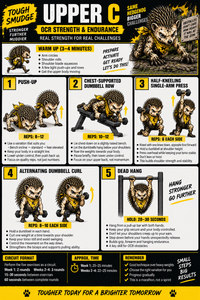
Upper C begins bringing the different elements together. Bodyweight pushing, pulling endurance, unilateral shoulder strength and hanging ability make this the most obviously OCR-focused workout of Cycle 1.
| EXERCISE | REPS | PURPOSE |
|---|---|---|
| Push-up | 8–12 | Relative pushing strength |
| Chest-supported dumbbell row | 10–12 | Back and pulling endurance |
| Half-kneeling single-arm press | 8 each side | Shoulder strength and stability |
| Alternating dumbbell curl | 8–10 each side | Biceps and pulling support |
| Dead hang | 20–30 seconds | Grip and hanging endurance |
Push-up
Use whichever variation allows 8–12 controlled repetitions.
Bench incline → standard floor push-up → feet-elevated push-up.
Keep the body in a strong line and lower under control before pushing back to the starting position.
Once 12 good repetitions become comfortable, the progression will eventually be to make the movement harder rather than simply chasing increasingly large numbers of repetitions.
Chest-supported dumbbell row
Raise the bench slightly and lie chest-down against it with a dumbbell in each hand.
Allow the weights to hang beneath the shoulders, then row them towards the body.
Pause briefly before lowering the dumbbells under control.
The bench supports the torso, allowing the movement to concentrate more directly on the upper back and pulling muscles.
Half-kneeling single-arm press
Kneel with one knee on the floor and the opposite foot positioned in front.
Hold one dumbbell at shoulder height and press it overhead while keeping the rest of the body controlled.
The single-sided load means the shoulder is working while the trunk has to resist rotation and movement.
This is where the distinction between upper-body training and core training begins to disappear, which is exactly what happens on an obstacle.
Alternating dumbbell curl
Hold a dumbbell in each hand and curl one weight at a time towards the shoulder.
Keep the upper body still and avoid using momentum to move the weight.
The elbow flexors already receive significant work through rows and pull-ups, but some direct strengthening should further support pulling ability.
Dead hang
Hang from the pull-up bar using both hands and maintain the position for 20–30 seconds.
Keep the grip secure and end the repetition before the hands unexpectedly release.
Cycle 1 is simply establishing the baseline. Over later cycles, hanging duration, grip variation and movement while hanging can all be progressively developed.
For OCR training, I want hanging ability to become something measurable rather than something that is only discovered when I arrive at an obstacle.
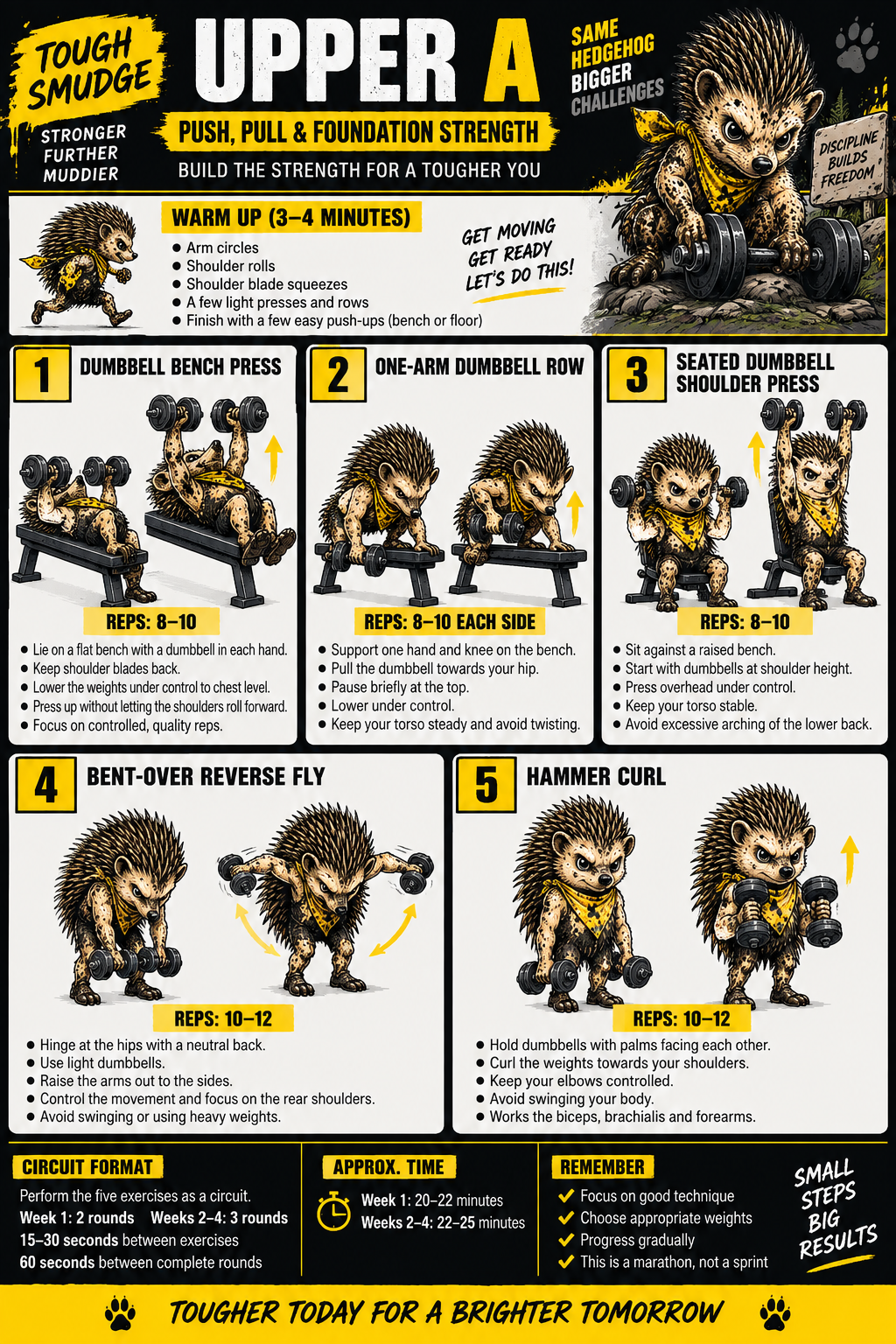
TOUGH SMUDGE UPPER WALLCHARTS
The three Cycle 1 workouts are also available below as quick-reference wallcharts. I use these in the gym so that the session can be followed without continually checking the full training guide.
Combining upper body and core
The Upper Body and Core programmes have deliberately been designed to work together.
| STRENGTH DAY | UPPER BODY | CORE |
|---|---|---|
| Strength Day 1 | Upper A: Push, Pull & Foundation | Core A: Brace & Stability |
| Strength Day 2 | Upper B: Pulling, Shoulders & Grip | Core B: Loaded & Functional |
| Strength Day 3 | Upper C: OCR Strength & Endurance | Core C: OCR & Instability |
The upper-body workout should normally be completed first, followed by the corresponding core workout.
Combined, the two sessions should take approximately 35–45 minutes, leaving the remaining days available for running, Peloton training, walking, mobility and recovery rather than creating six consecutive strength-training days.
What happens after Cycle 1?
Cycle 1 lasts four weeks, but these exercises are only the starting point.
At the end of the cycle, the weights, repetitions, pull-up progression and dead-hang time will provide measurable starting data for Cycle 2.
Later cycles can progressively introduce heavier pressing and rowing, more challenging push-up variations, reduced pull-up assistance, longer and more varied hangs, heavier carries and increasingly OCR-specific grip work.
The long-term objective is not simply bigger arms or a heavier bench press. It is an upper body capable of pushing, pulling, carrying and hanging repeatedly while the miles and fatigue continue to accumulate.
That is considerably closer to what Tough Mudder, and ultimately World’s Toughest Mudder, is going to ask of me.
This is the training programme I am developing and following as part of my own preparation for obstacle course and endurance events. It is not personalised fitness or medical advice. Exercise should be adapted to your own ability and circumstances, and any movement causing pain should be stopped.