
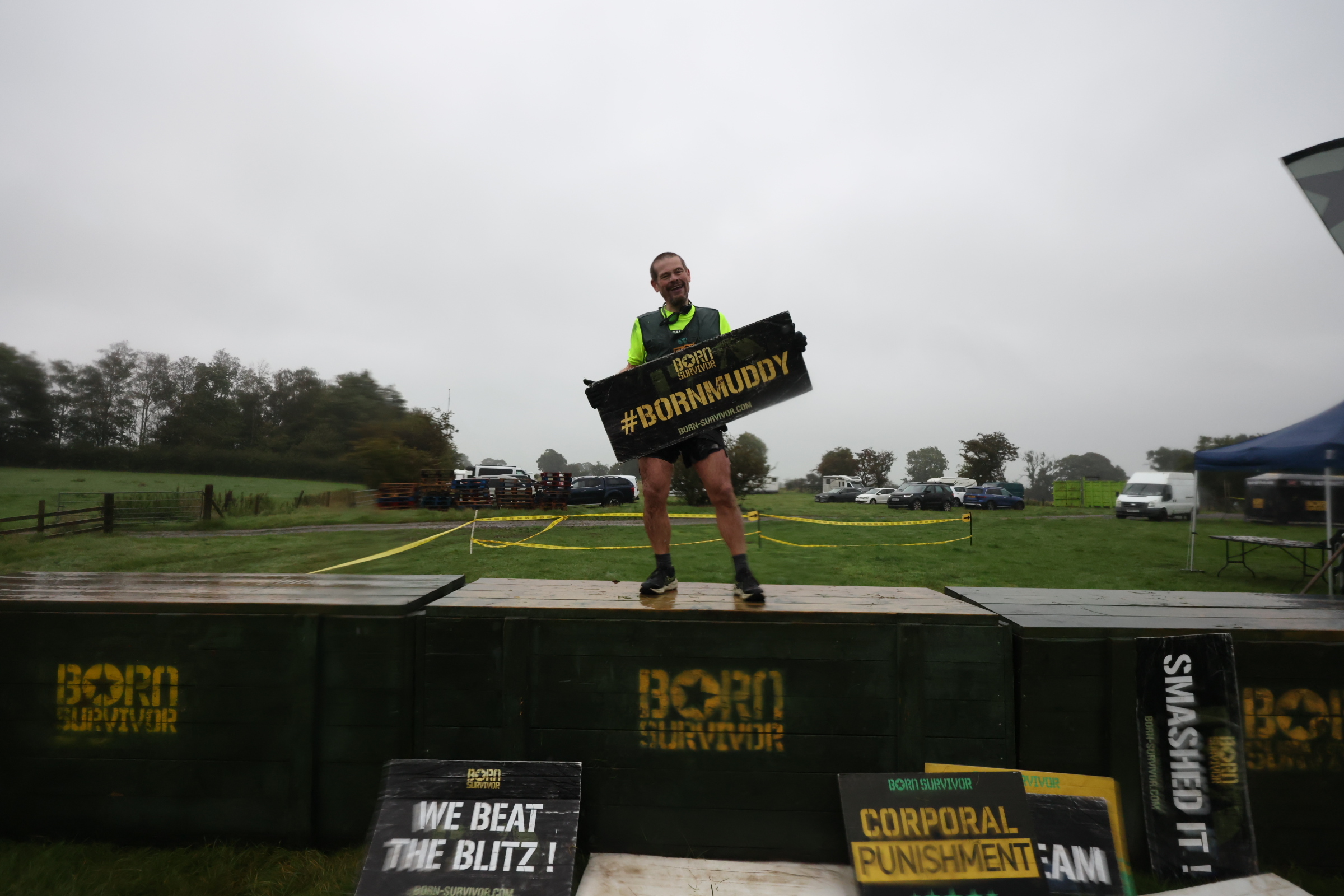
BORN SURVIVOR LANCASHIRE: COMPLETED, BUT NOT CONVINCED
Born Survivor Lancashire was always going to be an experiment.
It was my first obstacle course race outside Tough Mudder, my first experience of the Born Survivor format and, after upgrading my entry, my first attempt at its Elite Squadron.
I went into it not really knowing what to expect.
I came away having completed the 12K, collected the medal and T-shirt, learned quite a lot about where my OCR strengths and weaknesses currently sit and, importantly, avoided doing anything that might jeopardise Tough Mudder London South a week later.
So there were plenty of positives.
But I also came away fairly certain that Born Survivor probably isn’t an event I’ll rush back to.
And, frustratingly, despite completing the course, I have virtually no timing or GPS data from the day.
A VERY DIFFERENT KIND OF OCR
Born Survivor is unapologetically military-themed.
That runs through everything from the terminology and start area to the briefing and atmosphere around the Event Village.
Personally, I found some of it a little heavy-handed and slightly dated, but that is largely a matter of taste. More importantly, I wanted to see how the actual event compared with the Tough Mudders I have completed so far.
The whole setup felt considerably more rustic.
It wasn’t as polished as Tough Mudder, but Born Survivor is also a much smaller operation running far fewer events, so some difference is probably inevitable.
The morning did not get off to the smoothest start.
We were originally called towards the start area at around 9:20am ahead of the planned 9:45am Elite Squadron start.
After waiting there, we were eventually told to return to the Event Village and that we would be called again later.
There appeared to be an issue somewhere on the course.
We later learned that Para Plunge had been withdrawn on safety grounds.
Removing an obstacle because it isn’t safe is absolutely the right decision. I’d much rather an organiser delay an event than send people onto something they have concerns about.
The communication around the delay could have been better, though, and the whole thing felt rather disorganised.
Eventually we were called back.
There was another short delay getting everybody into the briefing and warm-up area before the military-style briefing and warm-up began.
Even then it was obvious that the ground conditions were going to be significant.
It had been raining heavily, the ground was saturated and even the relatively small number of Elite runners moving around the warm-up area were quickly turning it into mud.
That immediately made me question one part of my original plan.
THE SECOND LAP THAT WASN’T
The possibility of a second lap was the main reason I upgraded to Elite Squadron.
Complete the first 12K in time and Elite runners had the opportunity to head back out and do the course again without buying another entry.
On paper, potentially getting 24 kilometres and another complete set of obstacles for the same event made the upgrade very appealing.
But by the time we eventually started, I was already beginning to think that a second lap wasn’t going to happen.
The opening obstacle reinforced that.
Heartbreak Hill involved repeated climbs up a field, getting over rows of large straw bales before descending again and heading back uphill.
The slopes and turns were already extremely slippery.
And this was the first wave.
With hundreds more runners still to come through, I could only imagine what some of those sections were going to look like several hours later.
As the course continued, that became a recurring theme.
Born Survivor Lancashire was considerably hillier than I expected, with some steep climbs and descents on wet, muddy tracks.
I had Tough Mudder London South only seven days later.
There was absolutely nothing to gain by turning a useful 12K training event into an injury because I wanted to prove I could do another lap on increasingly churned-up ground.
So the second lap was quietly removed from the plan.
I still wanted to complete the first one properly.
PHYSICALLY, THINGS WERE GOING WELL
For most of the course, I was actually very pleased with how I was performing.
I settled into my own pace rather than worrying about the runners around me and worked my way through the obstacles.
The walls were particularly encouraging.
Some took me quite a while, and they weren’t always elegant, but I was getting over them.
That matters.
Upper-body strength has been one of the obvious areas I need to develop for World’s Toughest Mudder, so every wall I can now get myself over is progress.
Eventually I reached Commando Crossing.
And that was where the Elite result ended.
COMMANDO CROSSING
Commando Crossing was a long monkey-bar traverse across a muddy ditch.
The individual rungs were relatively close together, but after the heavy rain everything was soaking wet.
My hands were sliding on almost every bar.
I made it roughly halfway across before losing enough grip that I dropped.
I’m not particularly upset about failing the obstacle.
If anything, it confirmed something I already know.
Grip strength and upper-body endurance need more work.
That’s useful information, and exactly the sort of weakness these events are supposed to expose before I get anywhere near World’s Toughest Mudder.
What frustrated me was the consequence.
Under the Elite Squadron rules, failing an obstacle meant losing the Elite result and therefore not receiving the official finish time I had hoped to use as another training benchmark.
Rules are rules.
If I had entered because I wanted to compete for an Elite placing, I’d have absolutely no complaint about losing that placing after failing an obstacle.
But I wasn’t there chasing a podium.
I was there to complete a challenging obstacle course, learn from it and hopefully record another useful piece of performance data.
From that point onwards, the competitive side of the event was effectively over for me.
The objective became much simpler.
Finish the course.
STILL PLENTY LEFT TO DO
I continued around, getting over, under and through everything that followed.
The final large wall, The Beast, took some effort.
Eventually one of the boards flexed just enough for the edge of my trainer to find some purchase and I managed to get myself over the top.
As I rolled over it, my right calf cramped.
Rather inconvenient timing.
It was the first real issue I’d had with my legs all day, though, and once I started running again it quickly disappeared.
That in itself was encouraging.
The course had been steep, muddy and physically demanding, yet my legs were still behaving themselves.
Then came the final section.
And this was where my view of the event changed more significantly.
THE BLITZ
The penultimate obstacle was Born Survivor’s cold-water obstacle, followed by The Blitz, the large finishing wall.
My first attempt at The Blitz wasn’t actually bad.
I got very close to the top but couldn’t quite make it.
Sliding back down, I managed to hit my head against the obstacle.
That certainly woke me up.
I stepped away for a moment and watched some of the other Elite runners making their attempts.
Some succeeded.
Some failed.
Some appeared to receive assistance.
What I hadn’t expected was the PA commentary.
Individual Elite runners and their attempts were being commented on over the microphone, including failures.
I’m sure some competitors probably enjoy that atmosphere.
I didn’t.
To me, it felt closer to being ridiculed for failing than being encouraged to have another go.
That is perhaps one of the clearest differences between what I enjoy about Tough Mudder and what I experienced at Born Survivor.
At Tough Mudder, somebody failing an obstacle normally results in another Mudder offering a hand.
There is no embarrassment attached to it.
You attempt it, perhaps you conquer it, perhaps you don’t, and everybody carries on.
That cooperative atmosphere is a very large part of what drew me into obstacle course racing in the first place.
Eventually I decided I had given The Blitz enough attempts and would use the assistance rope fitted at the side.
I was told by an organiser that the rope was only for women and that using it would result in me being disqualified.
By this stage my Elite classification had already gone at Commando Crossing, so that wasn’t really much of a threat.
I said I was going to use the rope and get myself over the obstacle.
The exchange that followed felt unnecessarily confrontational and pretty much settled my opinion of the Elite format.
I got over.
I finished.
And that was enough.
COMPLETED. MEDAL COLLECTED.
From there it was onto the finish.
Medal collected.
T-shirt collected.
Obligatory cheesy finisher photograph taken.
Then it was back to the changing area, get cleaned up and head home.
Born Survivor Lancashire completed.
Unfortunately, the day’s final frustration was waiting for me on my wrist.
THE WATCH HAS FAILED AGAIN
Because I wasn’t going to receive a usable official Elite time, I at least expected to have my own activity recording from the watch.
Nope.
Another technical failure.
On my Ingleborough walk I had problems with the Wear OS activity tracking.
For Born Survivor I decided to try the Strava app instead.
That went even worse.
It recorded just 14 minutes and 43 seconds.
Somehow it captured the start and then later picked me up 10.23 kilometres away, drawing what was effectively a straight line between the two points.
So I completed a 12K obstacle course and came away without a reliable official time, elapsed time, pace, heart-rate trace or proper GPS route.
That is extremely frustrating.
The data isn’t just there because I like collecting numbers.
I need it to measure improvement, understand how I’m coping with different distances and terrain, and build a proper picture of my training as World’s Toughest Mudder gets closer.
The current watch therefore has one more important test.
Tough Mudder London South.
I’ll return to the tracking method that has at least successfully recorded my previous Tough Mudders and I’ll be checking it during the event rather than assuming it is still running.
If it fails again, I think the decision will have been made for me.
A replacement sports watch will need to move considerably higher up the shopping list.
WHAT DID I ACTUALLY LEARN?
Without the timing data, Born Survivor can’t really give me the quantitative benchmark I wanted.
But it still provided plenty of useful information.
First, I completed the 12K without injury.
I’m a little stiff afterwards, but nowhere near as stiff as I was after Tough Mudder Yorkshire.
That’s progress.
Second, my legs coped well with a surprisingly hilly course.
Third, the walls are improving.
Getting myself over obstacles that would previously have caused considerably more trouble is a very visible sign that the training is doing something.
And fourth, Commando Crossing showed exactly where more work is needed.
Grip strength. Upper-body endurance. Time hanging from bars.
All things already being addressed by the new Tough Smudge training programmes, but now with another very practical demonstration of why they matter.
There is another lesson too.
Choosing not to do the second lap was the correct decision.
A few months ago I might have looked at having paid for the Elite upgrade and felt I had to use that second lap.
Now the bigger picture matters more.
One extra lap of Born Survivor was not worth risking the Tough Mudder distances waiting for me seven days later.
World’s Toughest Mudder isn’t going to be reached by trying to win every training day.
Sometimes progress is knowing when enough is enough.
WOULD I DO BORN SURVIVOR AGAIN?
Probably not.
That’s not because the course was too difficult.
In many ways, the course itself was exactly what I wanted.
It was hilly, muddy, physical and challenging.
I completed it, learned from it and came away uninjured.
My issue was more with the event around the course.
The military presentation isn’t really my thing.
The organisation felt a little rough around the edges.
I didn’t particularly enjoy the Elite rules once I was no longer competing for a classified result.
And the atmosphere around the final obstacle, especially the PA commentary, simply wasn’t the sort of OCR experience I enjoy.
That doesn’t make Born Survivor a bad event.
It means it probably isn’t the right event for me.
And discovering that is part of trying different things.
I’m actually rather pleased that my Spartan events next year are booked in the Open category rather than a competitive wave. They will provide another opportunity to see how a different OCR organiser approaches the balance between challenge, competition and simply enjoying the course.
As for next September, if the calendars line up, I may use the weekend to try something different again.
Wolf Run is definitely on the radar.
ONWARDS TO LONDON
So there isn’t a beautiful spreadsheet of splits to finish this blog.
No verified pace.
No trustworthy GPS trace.
No official Elite finish time.
But there is still a result.
I turned up.
I completed 12 kilometres of hills, mud and obstacles.
I got myself over walls.
I found another weakness to work on.
I made the sensible decision not to chase a second lap when the conditions made the risk greater than the reward.
And I came away ready for the next start line.
Seven days later, Tough Smudge goes back to Tough Mudder at London South.
Another event.
Another test.
Another step towards World’s Toughest Mudder 2027.
And through all of it, another opportunity to keep raising awareness and support for Prostate Cancer UK.
The clock may have gone missing.
The purpose hasn’t.
Endure. Overcome. Make It Count.