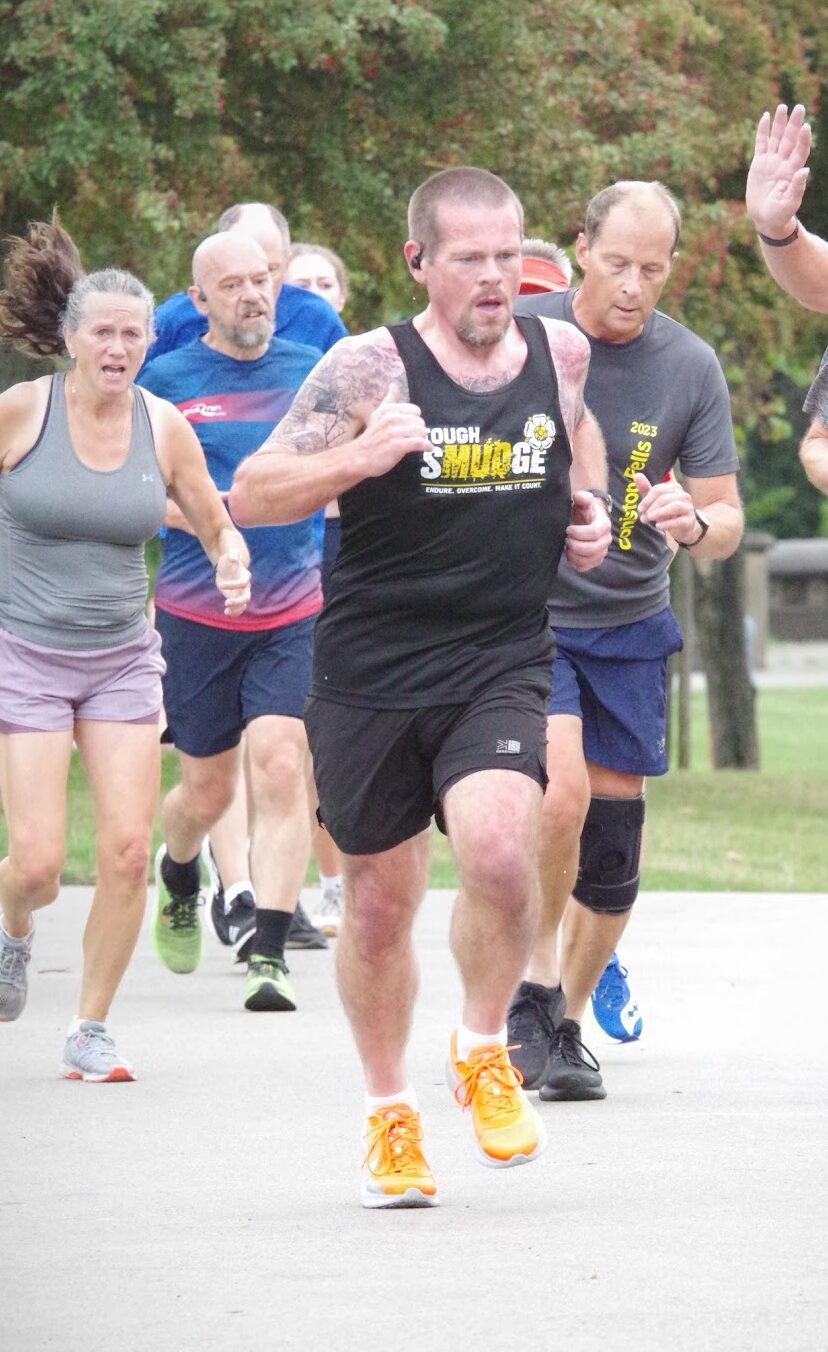
Yesterday I was back at Greenhead Park for parkrun, and for the first couple of kilometres things were going really well.
I set off strongly and found myself running just behind the 26-minute pacemaker. The pace felt controlled, I felt comfortable, and for a while I thought I might be heading towards a very good time.
Then, near the end of the first lap, I slipped.
It was not dramatic, but it was enough to aggravate the injury I picked up at my last Tough Mudder. From that point on, the run changed completely.
Looking back at the Strava data, the drop-off is pretty obvious. At around 2.2 km my pace went from roughly 5:00 per kilometre to closer to 6:00 per kilometre for much of the rest of the run.
I still finished in 27:38. It was not a PB, but that is not really the important part of this run.
The mistake was thinking I was fully recovered
The bigger lesson is that feeling better is not the same as being fully healed.
I had convinced myself that the injury from the last Tough Mudder had settled enough for me to run normally again. Clearly, it had not.
There were warning signs in my preparation too.
Before parkrun I did around 40 minutes on the Peloton, followed by roughly 20 minutes of Peloton outdoor walking classes. What I did not really do was any meaningful stretching or mobility work before running.
That is something I need to change.
The Peloton work might have got me warm, but being warm and being properly prepared for running are not necessarily the same thing, particularly when I am already carrying an injury.
Recovery needs to become part of the training
One of the things I am learning through the Tough Smudge journey is that training is not just about doing more.
It is also about knowing when to back off.
I am quite good at setting targets, adding events to the calendar and finding another session to squeeze in. What I am less good at is accepting that recovery is part of the process rather than time lost from it.
That becomes particularly important now.
Born Survivor is only two weeks away, and Tough Mudder London South follows the week after that.
Trying to force fitness gains over the next fortnight while carrying a niggle would probably be one of the worst things I could do.
The next two weeks need to look different
My focus now needs to shift away from simply building mileage and towards arriving at Born Survivor healthy enough to enjoy the event.
That means being more sensible with running, putting more emphasis on mobility and stretching, listening properly to any pain or discomfort, and using lower-impact training where appropriate.
I also need to learn more about recovery times and injury prevention rather than assuming that an injury has gone simply because it no longer hurts during everyday activity.
Yesterday’s parkrun was frustrating because I know I was running well before the slip.
But in another way it was probably a useful warning.
A 27:38 parkrun while managing an aggravated injury is not a disaster.
Turning a small injury into something that keeps me away from Born Survivor, London South, or the bigger challenges ahead would be.
Sometimes the best training decision is knowing when not to push.
Endure. Overcome. Make It Count.
Parkrun – Greenhead Park – 26.08.29
Recorded on the watch and imported into Tough Smudge from the activity file. GPS and biometric values are device-recorded estimates.
The route
Interactive GPS trace shown in Tough Smudge yellow. Satellite tiles are supplied by Esri; the standard map uses OpenStreetMap. Drag to pan and use the controls to zoom or switch background.